RS660 Brake pads comparison
Aprilia RS660, Brake Pads, Braking Efficiency, Racing Data
Since my first rides on the RS660, I have noticed that both the initial bite and overall braking efficiency feel well below the motorcycle's and tires' potential. Since the RS660 uses the same front calipers as most European supersport machines, a wide variety of aftermarket pad compounds are available as a direct fit. As a result, I selected a set of road-legal sintered pads that reduced the required lever force by approximately 25–30% and delivered a noticeably sharper initial bite compared to the OEM compound.
Summary
Modern motorcycle brake pads can maintain CoF above 0,6 even in cold conditions
Road use, particularly in cold or wet conditions, will require a fully functioning and sensitive ABS — the stronger initial bite of sintered pads significantly increases the risk of front wheel lock-up under rapid brake application
Brake pad swap alone can reduce the force at the brake lever by approximately 25–30% (in comparison with OEM pads)
Bedding of sintered pads requires a series of progressive braking events, with moderate and hard braking playing the key role in establishing the initial transfer layer — in this experiment, full performance was reached after approximately 50 braking events. Always follow the manufacturer's instructions, and never skip bedding before track use or daily road riding
Key findings
Methodology
To quantify braking performance, I measured two parameters simultaneously: applied brake pressure and resulting longitudinal deceleration, captured by the motorcycle's OEM 6-axis IMU. The ratio of these two parameters indicates how much pressure — and indirectly, how much lever force — is required to achieve 1 G of deceleration.
To access these parameters, I installed a data logger with CAN bus access using firmware dedicated to the AP RSV4. As established in previous experiments, the RS660 shares multiple electronic modules with AP's flagship models, including integrated brake pressure sensors; however, these are not accessible via the RS660's AiM CAN protocol.
After logger setup, I cleaned and degreased both the brake pads and rotor, then collected baseline data using OEM pads. The experiment was conducted at a closed racetrack featuring main and back straights for high-speed aggressive braking and slow technical corners requiring precise trail braking.
After collecting the baseline data, I replaced the OEM pads with sintered pads and completed a 20 km commute to initiate bedding. Before the second data collection session, I cleaned and degreased the pads and rotor to match the surface conditions of the baseline run.
For a valid comparison, only data recorded above 50 km/h were included, within a longitudinal deceleration window of -0.1 G to -0.85 G. Data points captured during brake release were excluded, as they reflect lever trail-off behavior rather than pad friction characteristics.
Analysis
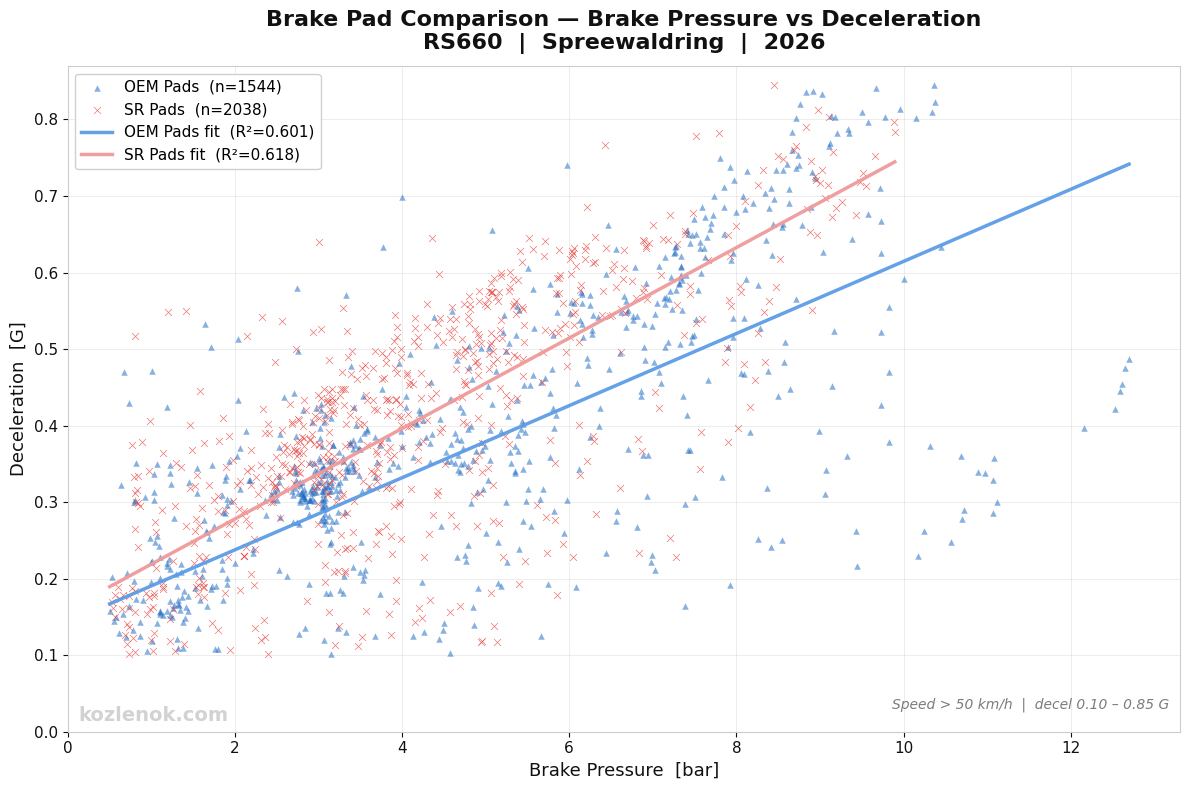
In the picture above, data is displayed as a scatter plot, with the X-axis representing brake pressure (bar) and the Y-axis representing longitudinal deceleration (G). Trend lines represent both data sets for ease of comparison. OEM brake pads are represented with blue triangle markers and a blue trend line; sintered (SR) pads are represented with red cross-shaped markers and a red trend line.
As the data show, sintered pads are significantly more consistent in initial bite. Blue data points (OEM pads) are clearly visible in the lower-right region of the plot, indicating that during many hard braking events, the achieved deceleration was only -0.1 to -0.3 G despite applied pressure exceeding 7 bar — a characteristic lack of initial bite under high lever load.
As the trend lines suggest, in the moderate braking range of -0.4 to -0.5 G, sintered pads required approximately 1.8 bar less system pressure to achieve the same deceleration. This translates to roughly 25% less effort at the brake lever.
Brake Pads bedding
Before the comparison data was processed, the sintered pads underwent a dedicated bedding session to ensure full contact between the pad compound and the rotor surface. This bedding data was excluded from the pad comparison analysis.
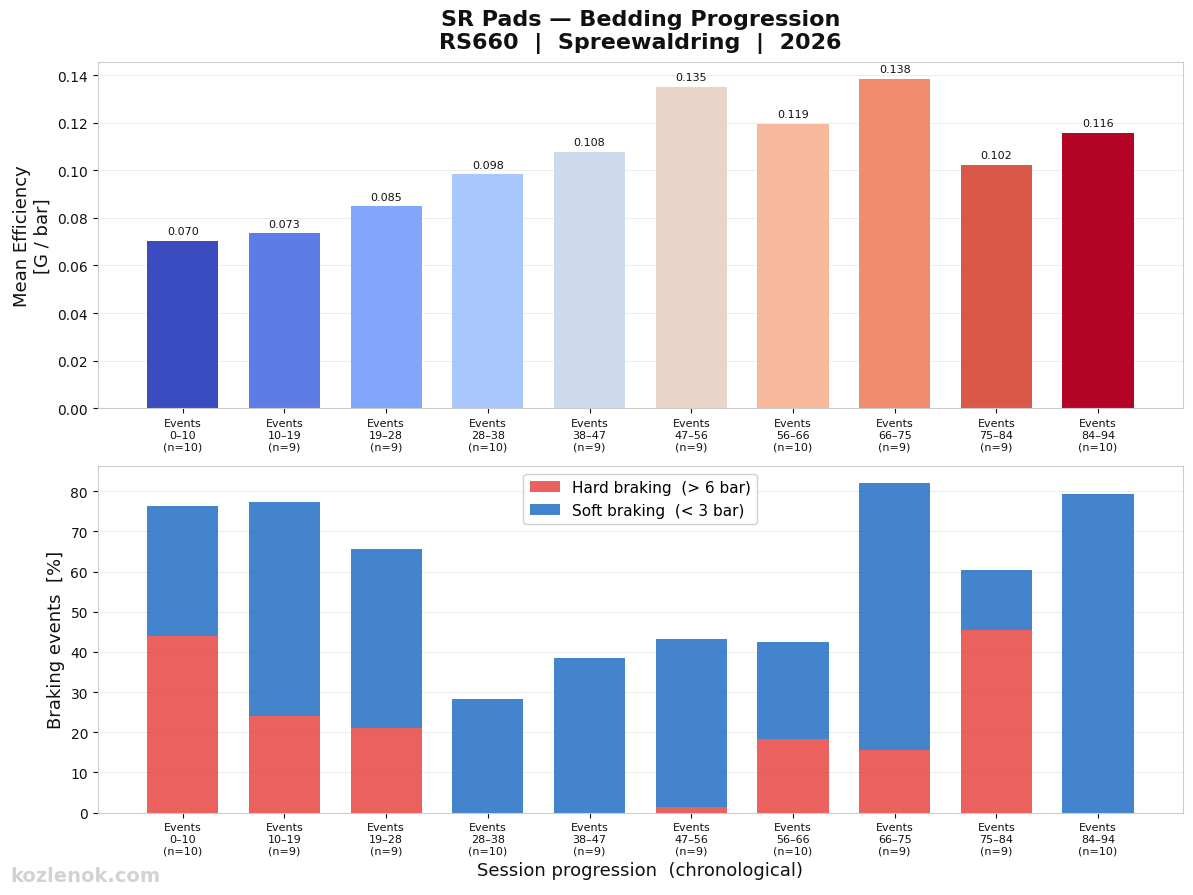
The chart above shows how braking efficiency — expressed as deceleration per bar of applied pressure [G/bar] — evolved across 94 logged braking events during the bedding session. Efficiency started at 0.070 G/bar and reached approximately 95% of its peak after around 50 braking events, then stabilized at 0.130–0.138 G/bar for the remainder of the session.
Notably, the initial rise was driven primarily by hard braking events in the first 30 stops, which generated sufficient heat and contact pressure to transfer pad material onto the rotor surface. The subsequent moderate braking events consolidated the transfer layer, bringing the pads to their full operating efficiency.
The exact number of braking events required for bedding varies substantially between pad compounds and rotor materials.
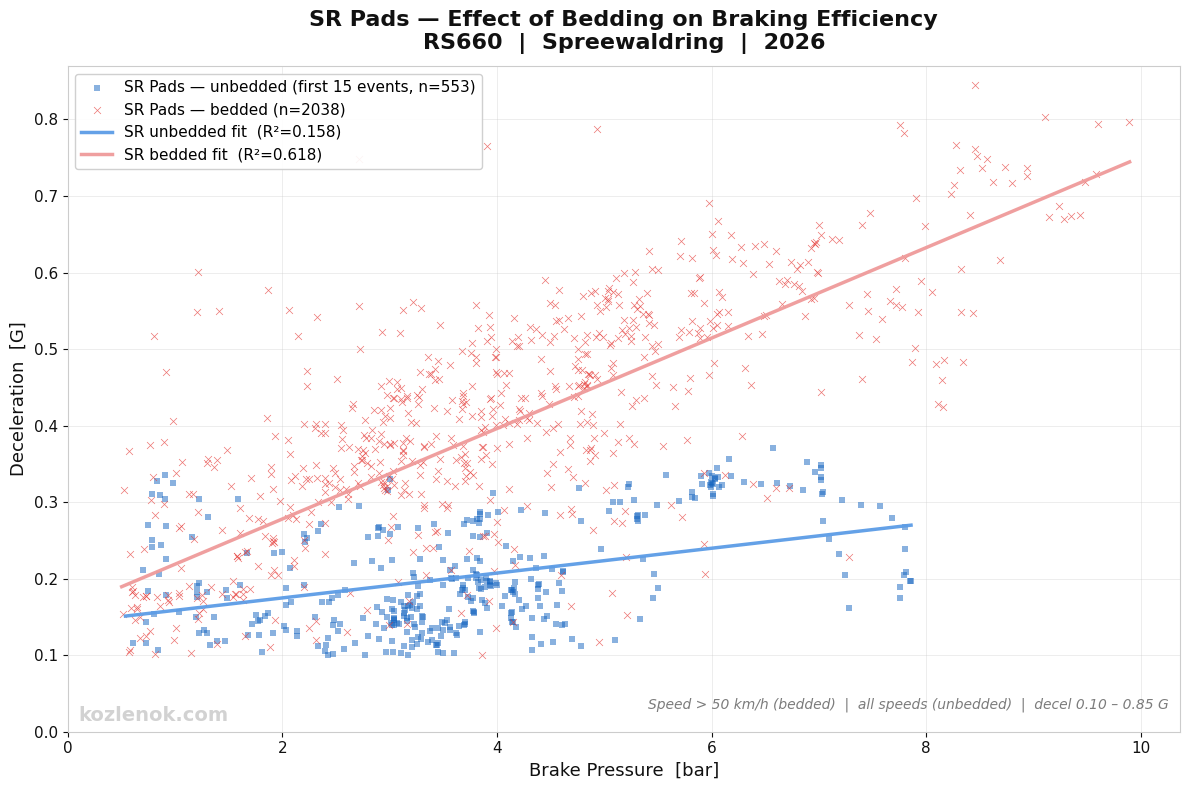
The chart above compares the same sintered brake pads before and after bedding, using identical hardware and the same rider. Without bedding, the pads delivered only 0.15–0.27 G of deceleration regardless of applied pressure — meaning brake pressure had almost no consistent effect on stopping power. After proper bedding, the relationship becomes strong and predictable, with deceleration scaling linearly with lever input up to 0.75 G. From a safety perspective, riding on unbedded sintered pads in traffic or on a track is a significant risk — the rider applies what feels like sufficient lever force, but the actual stopping power is dramatically lower than expected.