Less preload, same dive: what 2 turns out did to RS660 fork
Aprilia RS660, Suspension Setup, Data Acquisition, Suspension Potentiometer
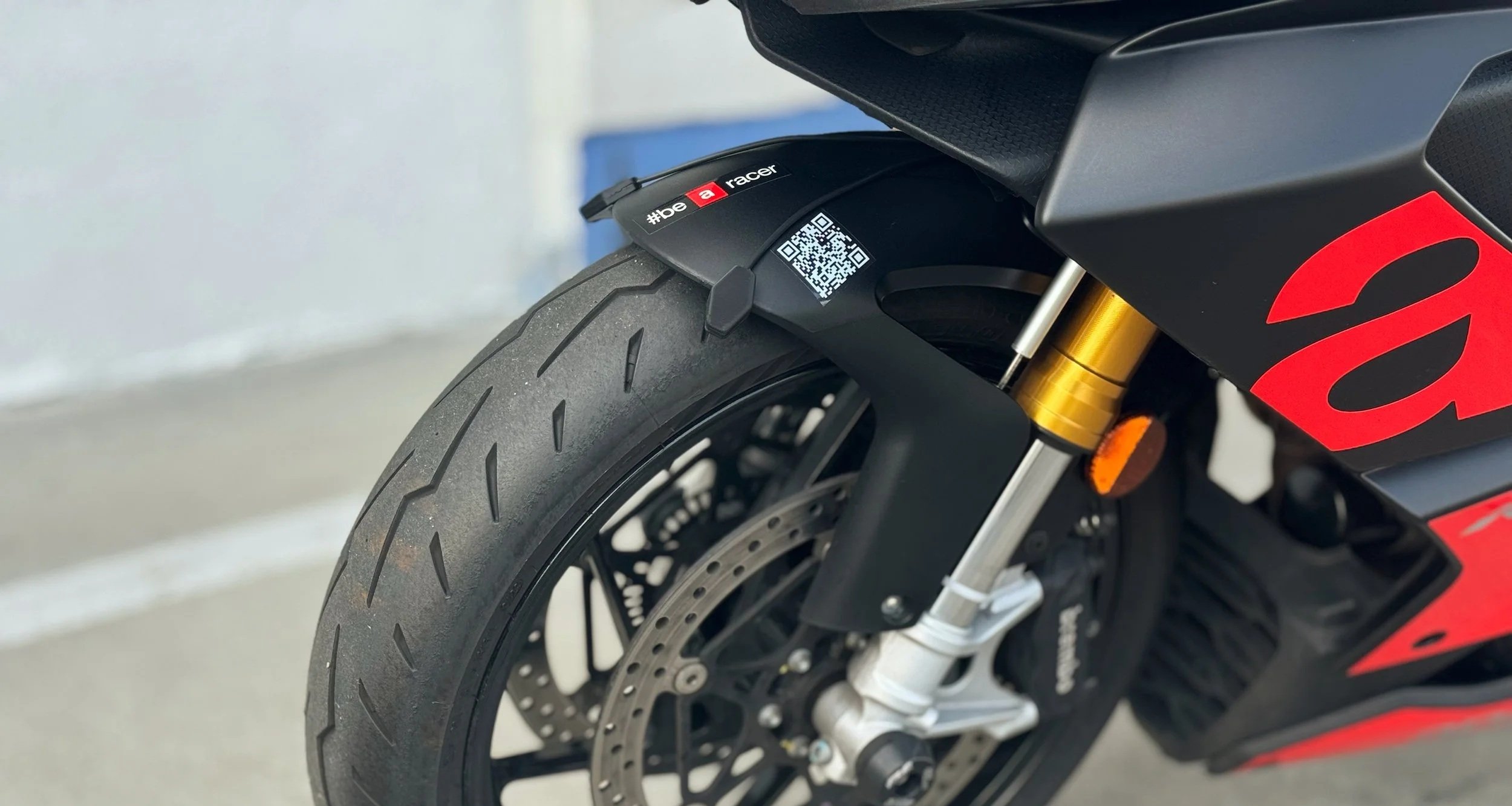
On my Aprilia RS660, the front fork felt like it wouldn't compress, even under my hardest braking
(about 1 G). The data from 29 September at Spreewaldring showed the same thing.
At the hairpin, I braked at 1.0 G, hard enough to lift the rear wheel. The bike carries an AiM data logger with a linear potentiometer on the front fork (500 Hz), so I could see exactly what happened: the fork stopped at 98 mm of its 120 mm travel. By the time I released the brakes and leaned in, it held only 89 mm, which left more than 30 mm unused right where it matters for turning (to shorten the trail).
Motivation
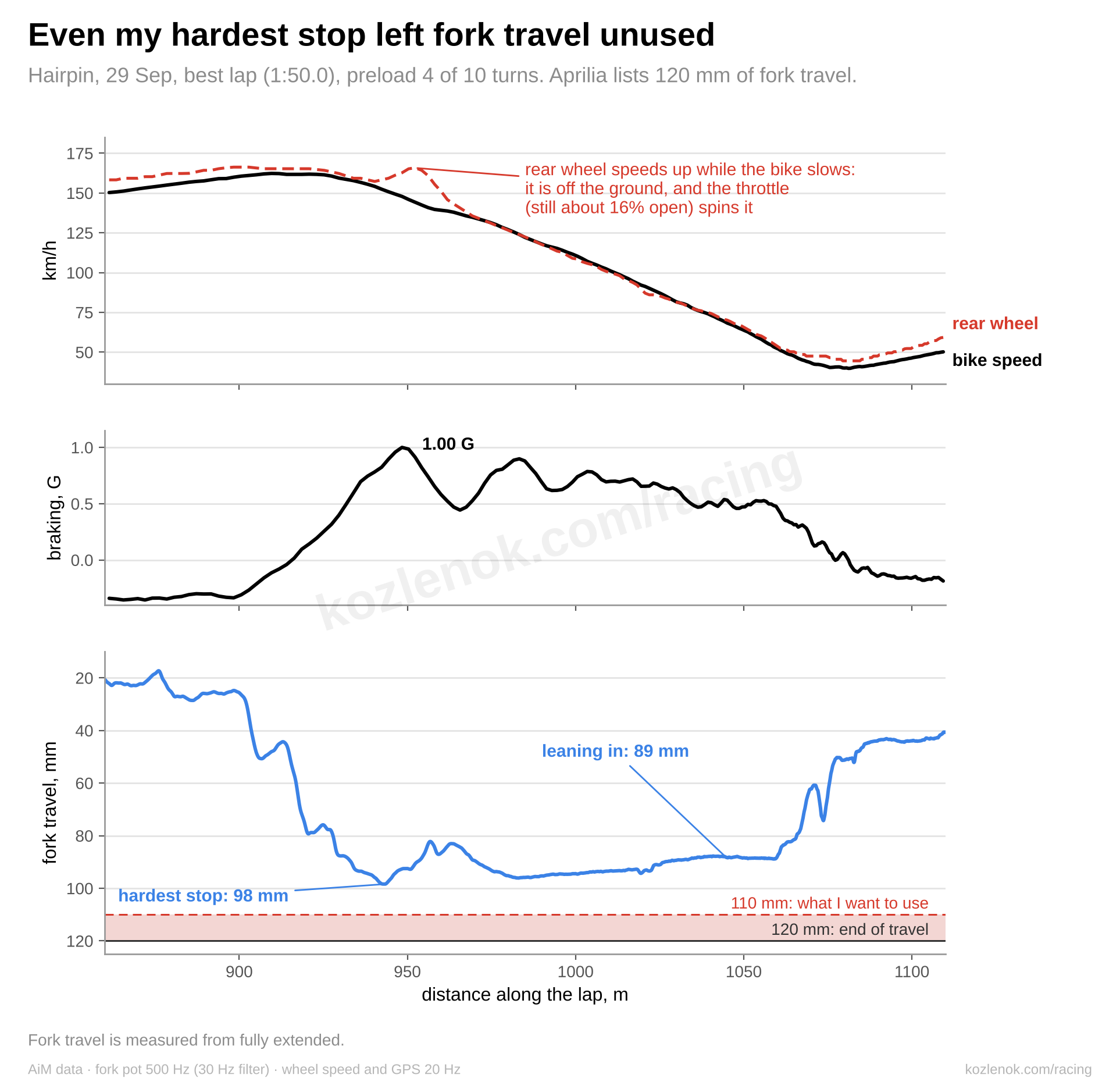
I want the fork to travel at least 110 mm at corner entry (keeping 10 mm as a safety margin).
More dive steepens the fork angle and shortens the trail, which should make the bike turn in quicker.
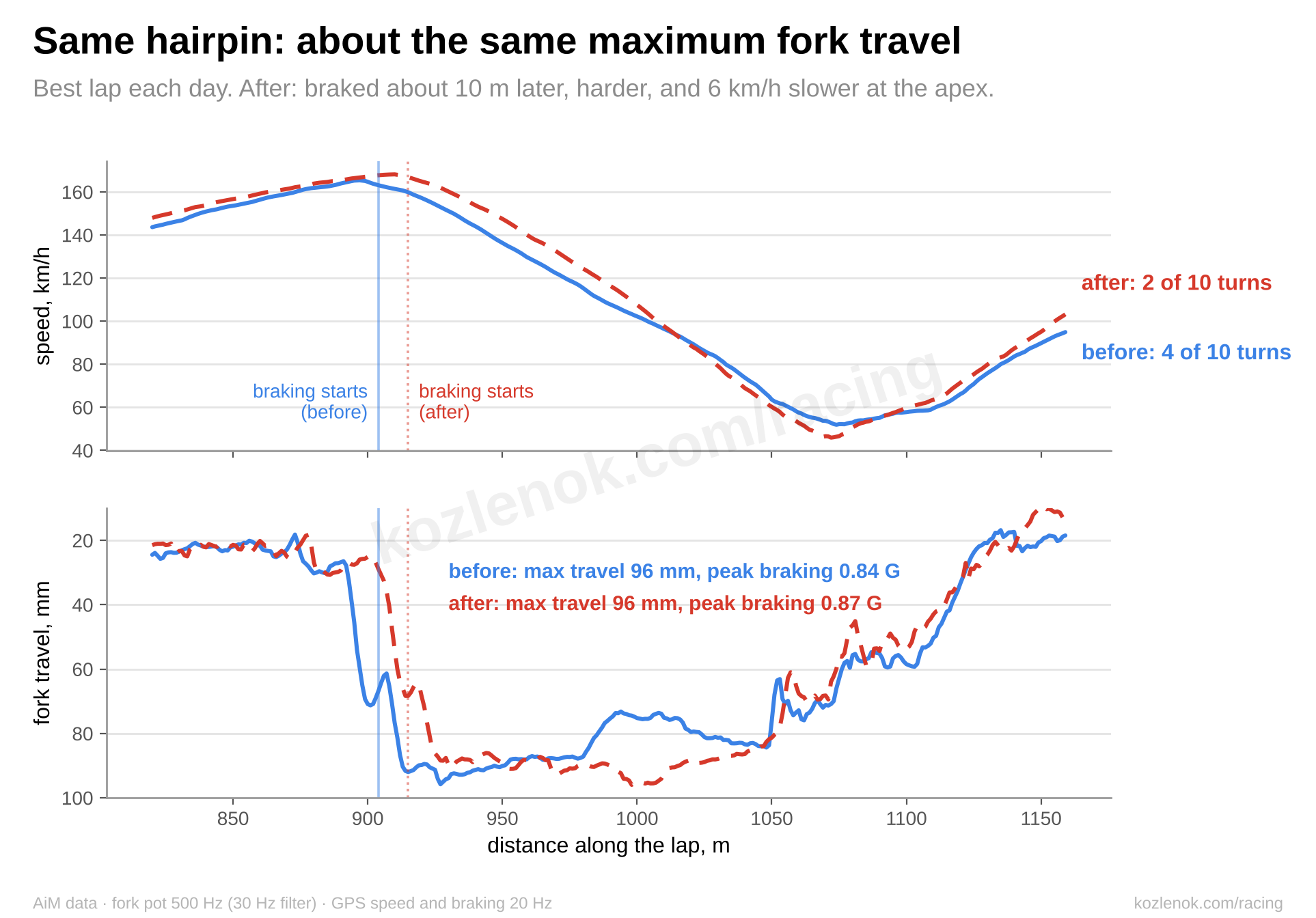
Preload was set at 4 of 10 turns in. The obvious first step was to take some out, so I went to 2 of 10 turns and changed nothing else (no Comp/Reb damping changes). Below is what the data shows.
Summary
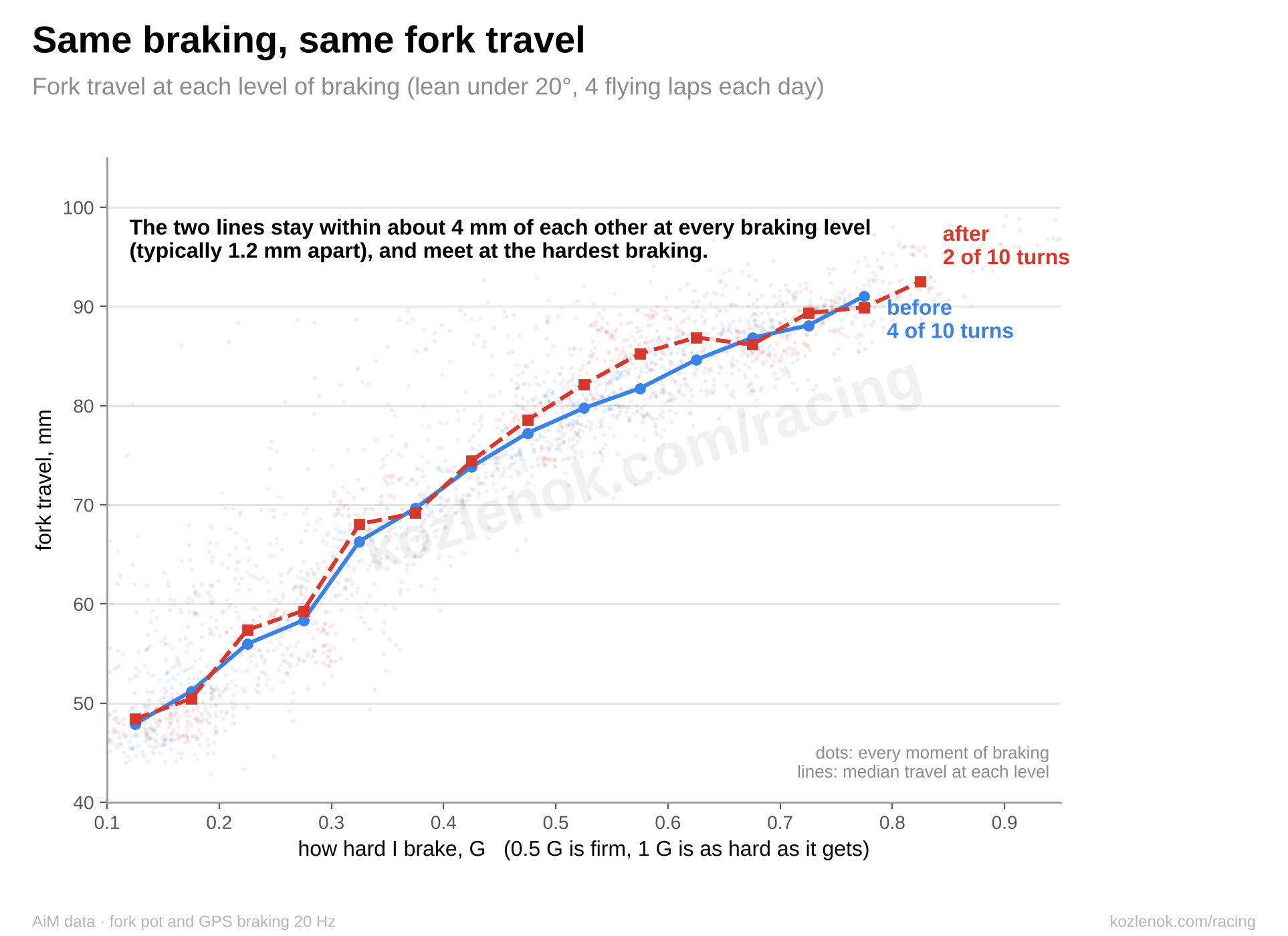
Fork travel at the same load: about 1–2 mm more everywhere (braking, coasting, mid-corner, accelerating). That's close to the noise, and it's what preload should do: it shifts the starting point, not the stiffness
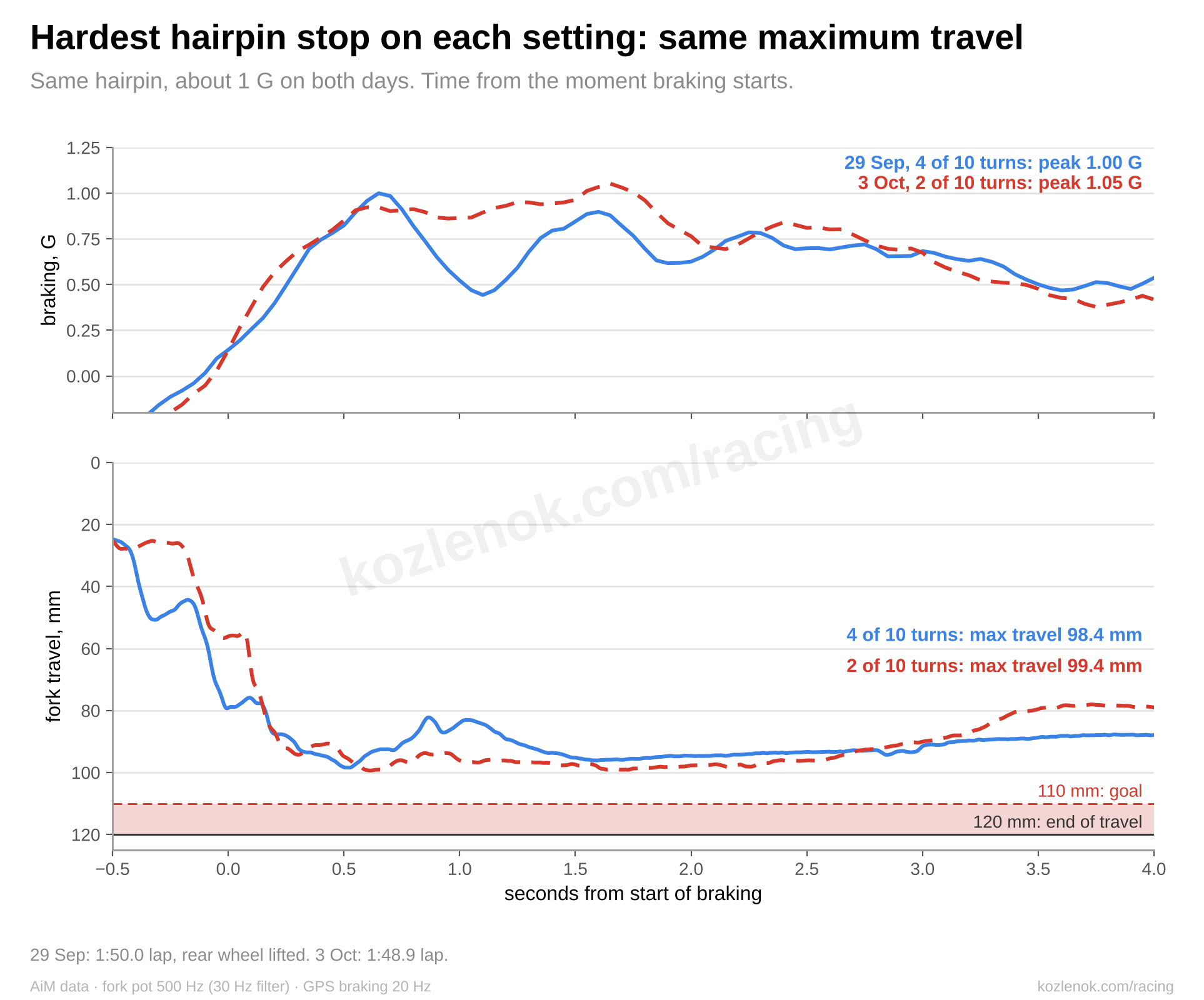
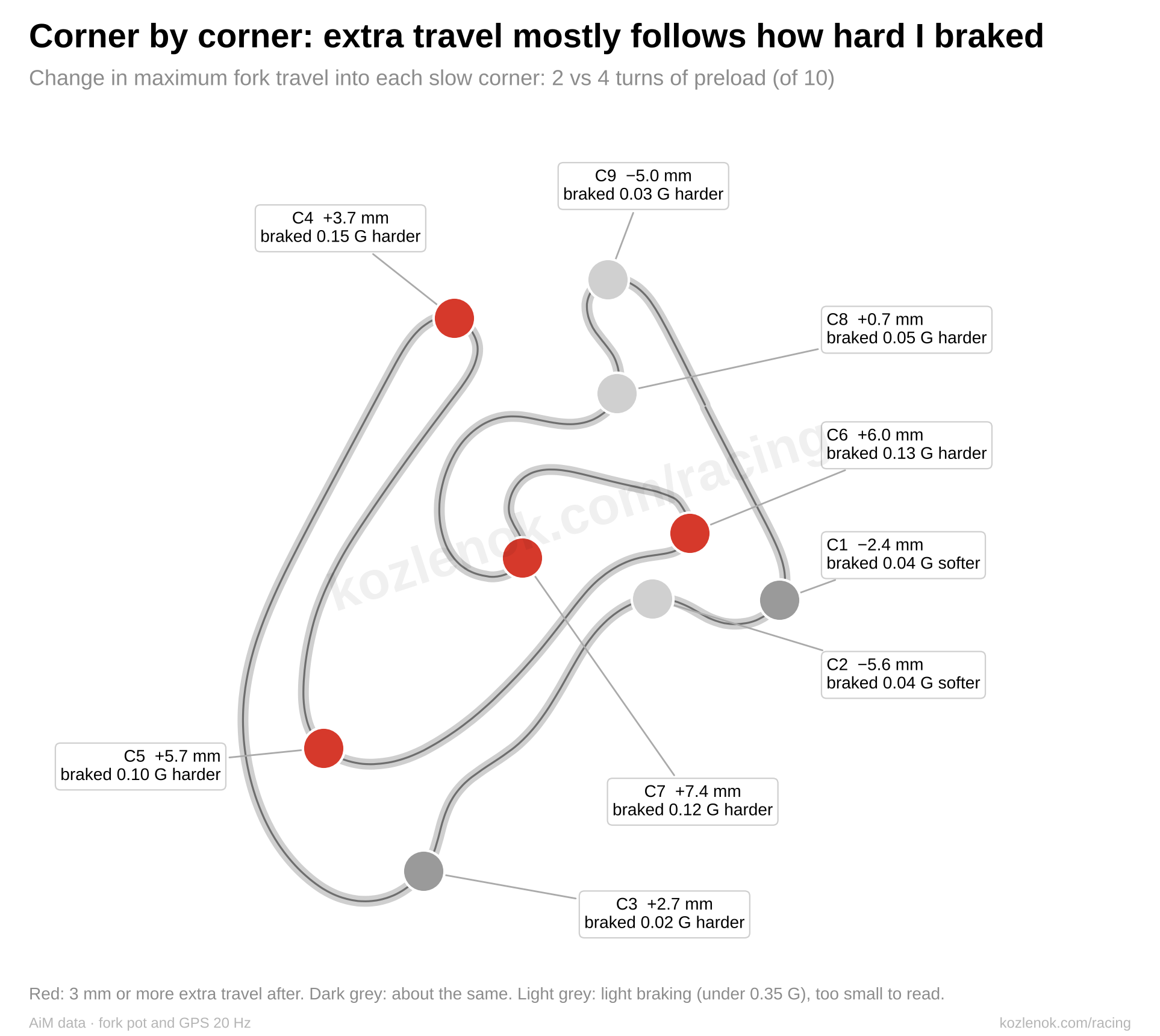
Maximum travel at the hardest braking: unchanged. At the same hairpin and about 1 G on both settings, it reached 98.4 vs 99.4 mm.
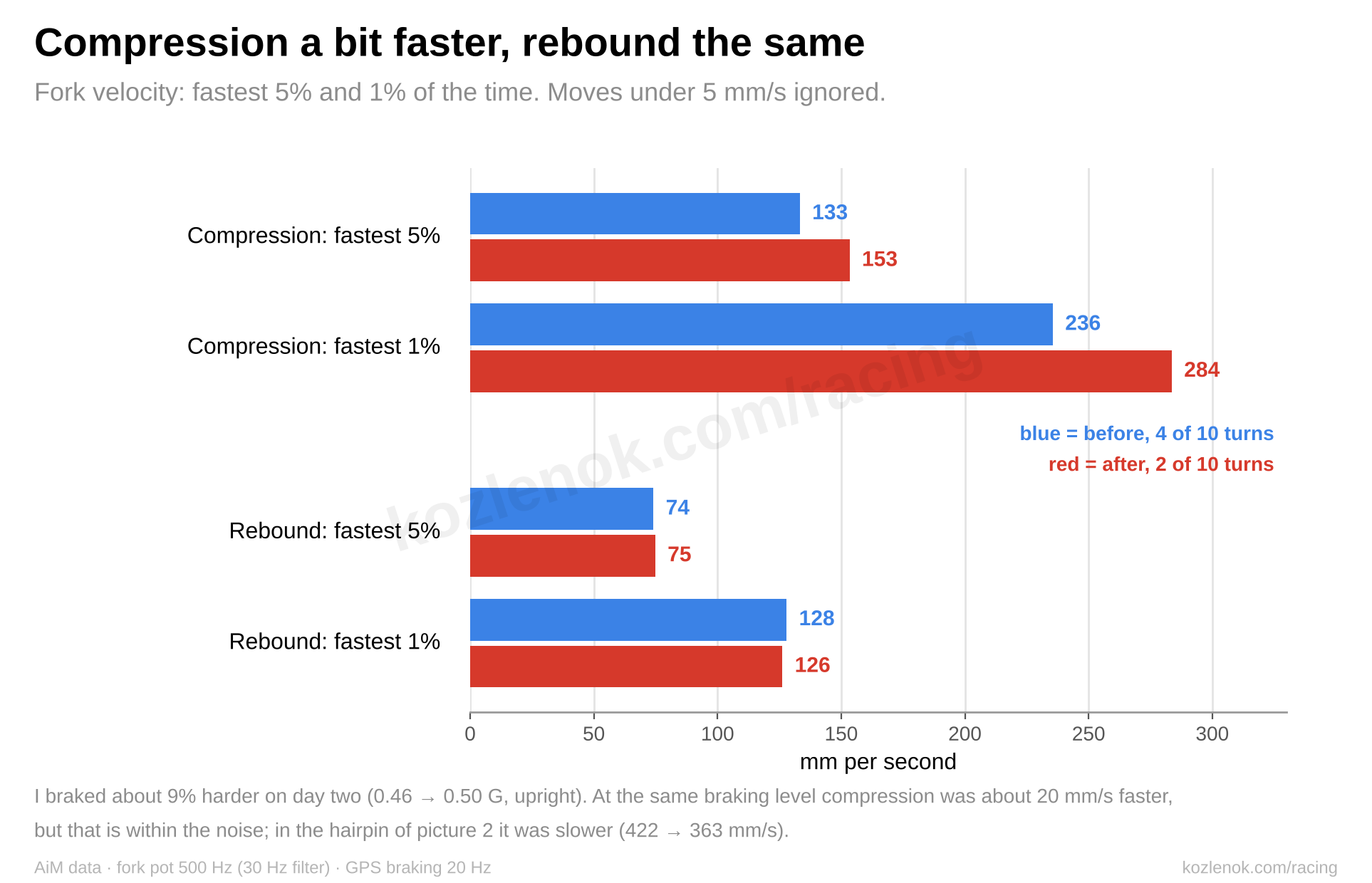
Compression velocity: about 20% higher, mostly because I braked about 9% harder on day two. At the same braking level, the difference is within the noise, and at the hairpin, compression was actually slower
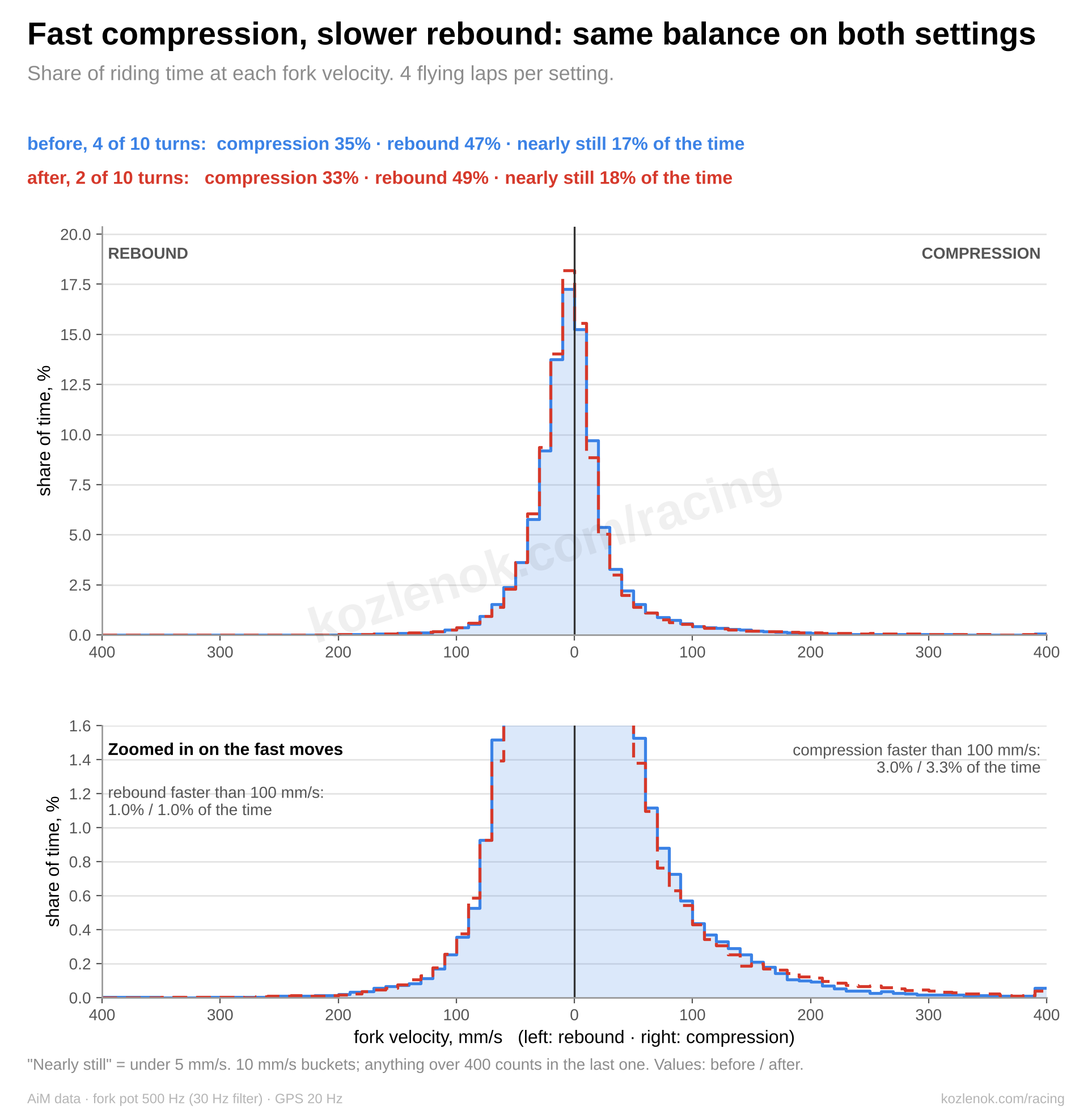
Rebound velocity: unchanged (fastest 1%: 128 vs 126 mm/s), which fits with no damping changes
Compression/rebound balance: unchanged; the velocity histograms almost overlap.
Rear lift: not caused by preload. The September lift came with the throttle still open (16%) and, as I remember, me moving on the bike; on 2 turns I braked just as hard without lift
What I didn't get: the fork still stops at about 98–99 mm of 120, and at turn-in it holds about 89 mm
Adjustment left: only 2 turns of preload remain, worth about another 1–2 mm. Preload can't reach the 110 mm goal
Potential solution
Quick fix: lower the oil level to enlarge the air gap in the fork. The trapped air works as a secondary spring that stiffens sharply at the end of the stroke. My data shows this: the fork moves about 60 mm per G of braking at 0.3–0.5 G, but only about 35 mm per G above 0.6 G. A bigger air gap softens that final part of the stroke without changing the main springs so that the fork can use more of its last 20 mm. It's cheap and reversible: make the same change on both legs, in small 5 mm steps, and never below the minimum level in the service manual.
Recommended fix: springs about 10% softer. This moves the whole travel curve deeper. My rough estimate is about 107 mm at 1 G with 10% softer springs, and 110 mm with 13%. I'm not doing this yet, because my pace is still going up: harder braking puts more load on the front, so the right springs today could be too soft in a few months.