RS660 Season 2026 Results
Aprilia RS660, Track Days, Racing, Racing Data Processing
In 2026, due to time constraints, I had only seven track days across three tracks. I spent most of my time at my “home” track, STC Spreewaldring, but I also got to try Oschersleben and Lausitzring.
At the start of the season, I set goals to find the best ergonomics setup, get more comfortable with the brakes, and be faster in corner entry. Below are my progress metrics and plots.
Summary
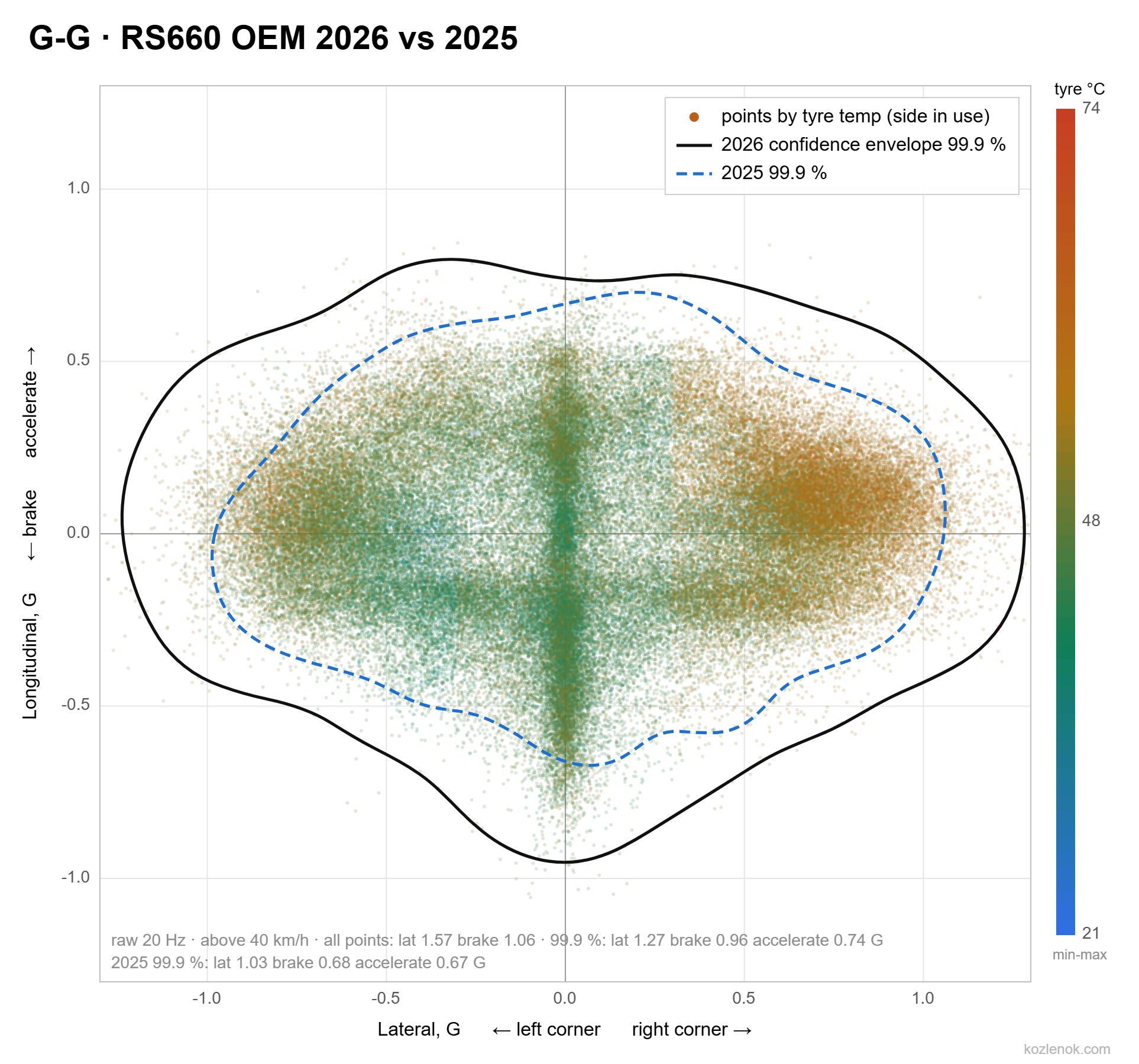
To compare properly, I overlapped G-G plots from 2026 and 2025. The cloud of points above represents the 2026 season and contains 209 laps and thousands of samples recorded with my data acquisition system.
For ease of comparison, I plotted two curves representing the 99.9% confidence interval. The solid black curve is based on 2026 data, and the dashed blue curve is based on 2025 data.
As the data (the black curve shape and the tire temperature map) show, I am still much more confident in all phases of the right corners than the left. However, my biggest improvement (the longest distance between the black and dashed blue lines) is in exiting the left corners. I analyzed the data and found that the problem isn't lean-angle comfort in the left corners, but the roll rate from right to left. Even though I managed to lean the bike in the left corners up to 53 degrees, fear/discomfort still limits me from flicking the bike left as fast as I can to the right.
My second-best improvement is braking. I’ve gotten more comfortable braking within the 0.8 to 1 G range. That led to less coasting over the lap and a more compressed front fork at the apex (braking later makes it easier to bring more trail braking into the corner). Operating close to 1 G on the short-wheelbase motorcycle required a lot of concentration because the rear wheel lifts at about 1,05 G, and even the race mode of the ABS can randomly start trailing pressure from the system, leading to an overly wide corner entry.
The rest of the improvement came from accumulated experience on these tracks, but also from a mix of factors below:
Motorcycle setup:
Fully released fork preload, but slightly overdamped rebound (to keep bike less nervous)
Tire temperature management and keeping the tread temperature below 70 degrees C (less TC intervention and more precise chassis behavior)
Sintered brake pads to reduce effort at the brake lever and therefore reduce the load on the steering clip-ons
Body position:
Seating all the way back on the seat helps me stretch my knees out more easily
Stretching the elbows toward the ground at lean and moving my head closer to the
clip-ons helped to reduce the motorcycle’s lean angle by 2-3 degrees, which already dramatically reduced traction control intervention, and I could accelerate out of the corner more efficientlyFocusing on the feet position on the rearset helped to have a more stable position on the motorcycle
Mindset (not my strongest domain):
Visual disconnection from speed on the dash freed up so much mental capacity and ability to fully observe every segment of the racing line, which helped to brake later
Trust in the tire and traction control (rule of thumb - if TC is not blinking, you are NOT even close to the safe limit of riding)
My biggest limit on the brakes was clearly a mental limit, because the bike can automatically handle pitch control and rear wheel liftoff, and my role was to squeeze the brakes to get more than 1 G on the initial braking phase
Next year's goals
Motorcycle setup:
Utilize 110mm (out of 120mm) at 1,1 G braking
Raise rear brake lever for better reach
Raise rear set by at least 30mm
Riding technique:
Stretch the elbow and be more agile with the upper body
Explore lower TC levels (below level 3)
Reach 100% of throttle before the bike gets straight out of the corner
Increase the roll rate, especially right-to-left
Be able to maintain a consistent pace for at least 3-4 laps (physical strength)